Thursday, October 28, 2010 - Union Station 9 AM - 5 PM
the impusle is to share, but i withhold. certain things can be destroyed through their transmission, so today i withhold from sharing and fold into that place of protection my already articulated and re-membered recollection.
Thursday, October 28, 2010

Karen Elaine Spencer - sittin'
Wednesday, October 27, 2010 - Union Station 9 AM - 5 PM
when in the great hall turn west and look up at the arched window between the interior and exterior panes of glass. you may see a ghost-like silhouette of a person walking from one side to the other.
when in the great hall turn west and look up at the arched window between the interior and exterior panes of glass. you may see a ghost-like silhouette of a person walking from one side to the other.
Karen Spencer: Sittin’, Union Station, Thursday October 28, 2010 (NL)
 It is three thousand seven hundred and twenty-three minutes into Karen Spencer’s Sittin’ performance at Union Station. It is cold, and I am not the only one here. I recognize a festival-goer sitting with her. Together they gaze gently into the distance, in roughly the same direction, as if waiting for something or someone.
I know from having talked to Spencer earlier that her experience of the site has changed. One of the “Red Caps”, sitting in front of us, named Dan, introduced himself to her the other day, asking how she was doing and if she needed anything. Only in Canada, I think to myself, having recently moved back from the US. The drama I was waiting for finally arrived and it came in the form of a gentle query. No request to move on. No harsh what are you doing here and where is your ticket? Feeling somehow included in the formal social life of the station, no longer waiting for someone to notice and say something – perhaps to send her packing – Spencer is visibly more relaxed. Or at least it seems this way to me.
Spencer comes up and offers me her seat: it’s the best seat in the house, she says. I put aside my computer and just sit. At first I notice visual rhymes: two green bags, two yellow ones. But quickly, this time, possibly because of the set-up by Spencer, I find myself feeling more deeply rooted in the space. I'm reminded of a wonderful short story by Ursula K Le Guin called "The Direction of the Road". It is told from the perspective of an oak tree watching the world walk, gallop and drive by. Similarly, here, I feel like a node in the center of a world that is spinning at different speeds.
Today I am tired. Doing this bloging with a new baby at the breast has wrung me out -- its own form of durational performance. Even at a slight distance from the vents that blow just behind the row of chairs, I am chilled to the bone. I can feel it around my neck and creeping into my jaw. Nonetheless, sitting here with Spencer relaxes me. I let the rest of the world drift away and concentrate on the production of space. On inhabiting a thoroughfare. On experiencing architecture. On the subtleties of the intervention: sitting. A seemingly passive act rendered so very active in intensity.
Three thousand seven hundred and fifty seven minutes into the performance, I leave, refreshed.
Wednesday, October 27, 2010
Michael Fernandes: Doing Things with Strangers, Toronto Free Gallery, Wednesday October 27, 2010 (NL)
I'm meeting Michael Fernandes at noon at the Toronto Free Gallery. Today is the first of four days that Fernandes will be performing, from 12-5, locations TBA. As I walk along Bloor, I see him seated on a chain across the entrance to a car dealership. He stares into the street. There is something alluring about this image: solitary, lanky, long grey hair flowing. Tempted to approach, I walk on instead, giving him his space in case he is preparing for the performance. At 12:05, he's not at the gallery yet, so I decide that maybe what I saw wasn't actually preparation but was the performance itself. I walk back to the car dealership. Almost there, I see him walking towards me accompanied by a woman, a film-maker he introduces as Barbara Sternberg, an old friend. Fernandes offers me some peanuts in the shell and we walk back to the Toronto Free Gallery together. On the way, Fernandes asks me if I know where he can find an Angelic Harp. The three of us discuss Angelic Harps for a while. Then Fernandes offers us each a fig and suggests that we go see the artist's talk by the TouVA Collective. We agree. But first, he says, let’s stop for tea.
We go into a little teashop and Fernandes treats. While we're drinking he initiates a conversation about performance, value, scale and detail. We discuss the performance that happened last night and the talk yesterday afternoon. We then turn to the question of performance art and life: how do you see, represent, and disseminate work that has no iconic imagery? Work that is embedded in the everyday? The possibility suddenly occurs to me that, with no announcement, I am in the performance. That we have been performing - all three of us - the whole time. We finish tea. Walk over to the gallery. Listen to the talk. Gather together afterwards and reflect on the ways that it echoed the themes of our discussion over tea. We smile at each other. And so on. Each ritual constitutes a performance moment. Or does it?
Fernandes announces that he is going to Union Station to sit with Karen Spencer, and off he goes. Perhaps this is the next part of his performance for today, the next act. Perhaps these are all moments of performance, instances of Doing Things With Strangers - an echo of JL Austin’s Doing Things With Words that I can’t but reflect on after TouVa Collective's invocation of Austin yesterday. Subtle interventions into everyday life, each instantiating performance through an encounter with strangers – in this case, Barbara Sternberg and me. Or maybe I'm overthinking it and there was no performance at all today. As I follow Fernandes out of the gallery and prepare for the next part of my day, two festival goers come up and ask: have you seen Michael Fernandes? Is he performing? Has he started yet? Of course, I don’t know what to say.
Wednesday, October 27th 2010 (DB)
7a#11d Blog 2


Most performance artists insist that what they do is distinct from what is disparagingly termed “mere spectacle.” I take this to mean something like this: performance is not reducible to the images it might result in, which can be remarkably beautiful or grotesque, but rather consists in the ineluctable series of acts that unfold in time. This may seem obvious, or tautological, but it’s important to keep in mind right now since the work of some of the most influential performance artists, like Marina Abramovic, is largely experienced through finely staged and crafted documentation, and is now conceived in a way that performances can be restaged like theatre events, sometimes decades after the original performance. Yet it is the specific, vanishing singularity of actions in time that gives performance art its distinctiveness, and is also the place where the boundary between art and life begins to blur.
The Fluxus artists famously insisted that no real distinction should be made between art and life—art is life, and life is art. This, of course, raises the broader philosophical question of what constitutes “life” and “art” in this context. These questions were given special importance for me this morning when I headed off in search of Karen Elaine Spencer’s performance in Union Station, which was scheduled to take place between 9:00 AM and 5:00 PM. I purposely did not investigate in advance the nature of the performance but rather went there cold, hoping to encounter it accidentally like any other passerby on his way to catch a train to Montreal or Winnipeg. This proved considerably more difficult than I had expected. Lurking in front of the station, I found myself focusing in on a short, compact woman somewhere in her thirties dressed in tight jeans and a windbreaker, her straight blond tamped down by a toque. She looked upset, agitated, standing beside a suitcase packed to the point of bursting. Occasionally she stamped her feet as though about to launch into a tantrum, muttered to herself, and walked out in a semi-circle around the plaza in front the station. She did this repeatedly with such precision it struck me that it was part of a routine, and I was convinced that she was Karen Elaine Spencer and that this was the scheduled performance, or at least part of it. At some point she pulled an iPhone out of her pocket, stared at its screen, and began to cry, and I started to feel uneasy about the fact that I had been standing there watching her and even taking notes for a long time—after all, she might not be Karen Elaine Spencer! Then a woman I gradually realized was probably her mother arrived and she started yelling, in French, about how she had too much luggage with her, how she had to get rid of some things, and her mother told her that she had to calm down or else she would miss her train. By then I fully understood that this could not be Karen Elaine Spencer, and that I was not watching a work of performance art, but still I followed them into the station and to the line for the train to Quebec City. She was not Karen Elaine Spencer, was not a performance artist, was simply a woman on her way back home to some sad event, like a funeral. But then maybe she was Karen Elaine Spencer, maybe the performance consisted of posing as someone going to Quebec City under tragic circumstances. Or not. And so forth.
I later learned Karen Elaine Spencer was sick and the performance that day had been cancelled.


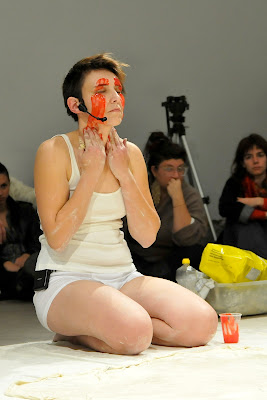

Despite the close relationship between art and life, and life and art, with most works of performance art it is fairly obvious that one is encountering a work of art, even if it involves activities that are in some form close to life. Sarajevo-born Canadian artist Bojana Videkanic’s performance, for instance, opened with her decked out in a sleeveless T-shirt and men’s underwear squat on a rectangle of cloth in front of a plastic bowl full of dough, bags of flour and bottles of vegetable oil. Fitted with a microphone, her breathing was loud, raspy, and furtive. First she kneaded a large lump of dough into a loaf shape, and then, setting it down on the cloth, she used a long, wooden rod to begin the process of spreading the dough out into a thin layer. Wetting the dough with oil, she slid her hands underneath it and pressed her fingers with caressing and fluttering movements. Stretched like that over her fingertips, the dough looked like human skin, quivering to the touch. When the dough had been stretched to its limit, Videkanic stood up, smeared messy red lines of paint down either side of her face and body, and began singing a song in Serbo-Croatian, a traditional song that is associated with Bosnia. Eventually she stretched out on the dough, and, singing plaintively and out of tune, she pulled the dough completely over her with just her bare feet sticking out. She looked as though she was wrapped in a shroud. The piece was quietly heartbreaking, evocative as it was Videkanic’s family and history (her family left in 1995), and of a world that was permanently destroyed by the war.


Canadian Jolanta Lapiak’s “De-hearingization,” on the other hand, takes a wholly differenct approach to performance than that of Videkanic and Stampe. Rather than focusing on the actions of one or more performers, her piece consisted of orchestrating participatry experiencescentered around destabilizing our hearing-centric concepts of language and communication. Accompanied by several other deaf performers, Lapiak had audience members’ mouths taped shut and ears plugged, then they were herded into small groups where they were taught rudimentary sign language without relying on hearing. At the end of the performance, everyone gathered in a circle around a paper chain made from torn out pages from a dictionary and broke the links in the chain. Like sight, hearing is a fundamental communicative sense, and relating to the world without it inevitably involves shifts in focus and priorities. Lapiak’s performance gestures toward recreating an aspect of this experience for those whose hearing is intact with the aim of making the point that language and communication are not in and of themselves dependent upon a particular organization of the senses.

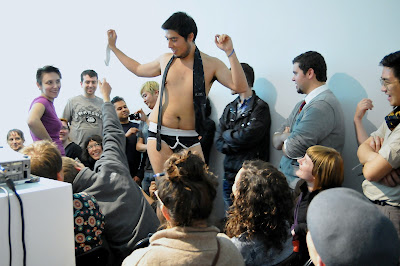
Performance art can be a somewhat heavy affair, trafficking as it often does in big ideas and issues—personal and national identity, the depredations of history and contemporary consumer culture, the unstable contents of the unconscious, the nature of language and art. So it is always a relief, especially in the context of a festival, when there is an occasion to laugh. Bogota, Columbia based artist Carlos Monroy opened his “CMG Performance Art Services” with a Power Point presentation. “Confident, dynamic, versatile, independent,” Monroy said of his company, which artists were invited to invest in.



Photos of Joakim Stampe by Henry Chan

Photo from Bojana Videkanic's performance, by Henry Chan:

Most performance artists insist that what they do is distinct from what is disparagingly termed “mere spectacle.” I take this to mean something like this: performance is not reducible to the images it might result in, which can be remarkably beautiful or grotesque, but rather consists in the ineluctable series of acts that unfold in time. This may seem obvious, or tautological, but it’s important to keep in mind right now since the work of some of the most influential performance artists, like Marina Abramovic, is largely experienced through finely staged and crafted documentation, and is now conceived in a way that performances can be restaged like theatre events, sometimes decades after the original performance. Yet it is the specific, vanishing singularity of actions in time that gives performance art its distinctiveness, and is also the place where the boundary between art and life begins to blur.
The Fluxus artists famously insisted that no real distinction should be made between art and life—art is life, and life is art. This, of course, raises the broader philosophical question of what constitutes “life” and “art” in this context. These questions were given special importance for me this morning when I headed off in search of Karen Elaine Spencer’s performance in Union Station, which was scheduled to take place between 9:00 AM and 5:00 PM. I purposely did not investigate in advance the nature of the performance but rather went there cold, hoping to encounter it accidentally like any other passerby on his way to catch a train to Montreal or Winnipeg. This proved considerably more difficult than I had expected. Lurking in front of the station, I found myself focusing in on a short, compact woman somewhere in her thirties dressed in tight jeans and a windbreaker, her straight blond tamped down by a toque. She looked upset, agitated, standing beside a suitcase packed to the point of bursting. Occasionally she stamped her feet as though about to launch into a tantrum, muttered to herself, and walked out in a semi-circle around the plaza in front the station. She did this repeatedly with such precision it struck me that it was part of a routine, and I was convinced that she was Karen Elaine Spencer and that this was the scheduled performance, or at least part of it. At some point she pulled an iPhone out of her pocket, stared at its screen, and began to cry, and I started to feel uneasy about the fact that I had been standing there watching her and even taking notes for a long time—after all, she might not be Karen Elaine Spencer! Then a woman I gradually realized was probably her mother arrived and she started yelling, in French, about how she had too much luggage with her, how she had to get rid of some things, and her mother told her that she had to calm down or else she would miss her train. By then I fully understood that this could not be Karen Elaine Spencer, and that I was not watching a work of performance art, but still I followed them into the station and to the line for the train to Quebec City. She was not Karen Elaine Spencer, was not a performance artist, was simply a woman on her way back home to some sad event, like a funeral. But then maybe she was Karen Elaine Spencer, maybe the performance consisted of posing as someone going to Quebec City under tragic circumstances. Or not. And so forth.
I later learned Karen Elaine Spencer was sick and the performance that day had been cancelled.


Photos of Bojana Videkanic by Henry Chan


Despite the close relationship between art and life, and life and art, with most works of performance art it is fairly obvious that one is encountering a work of art, even if it involves activities that are in some form close to life. Sarajevo-born Canadian artist Bojana Videkanic’s performance, for instance, opened with her decked out in a sleeveless T-shirt and men’s underwear squat on a rectangle of cloth in front of a plastic bowl full of dough, bags of flour and bottles of vegetable oil. Fitted with a microphone, her breathing was loud, raspy, and furtive. First she kneaded a large lump of dough into a loaf shape, and then, setting it down on the cloth, she used a long, wooden rod to begin the process of spreading the dough out into a thin layer. Wetting the dough with oil, she slid her hands underneath it and pressed her fingers with caressing and fluttering movements. Stretched like that over her fingertips, the dough looked like human skin, quivering to the touch. When the dough had been stretched to its limit, Videkanic stood up, smeared messy red lines of paint down either side of her face and body, and began singing a song in Serbo-Croatian, a traditional song that is associated with Bosnia. Eventually she stretched out on the dough, and, singing plaintively and out of tune, she pulled the dough completely over her with just her bare feet sticking out. She looked as though she was wrapped in a shroud. The piece was quietly heartbreaking, evocative as it was Videkanic’s family and history (her family left in 1995), and of a world that was permanently destroyed by the war.

photo of Bojana Videkanic by Henry Chan

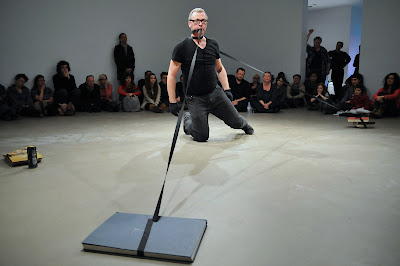 Photos of Joakim Stampe by Henry Chan


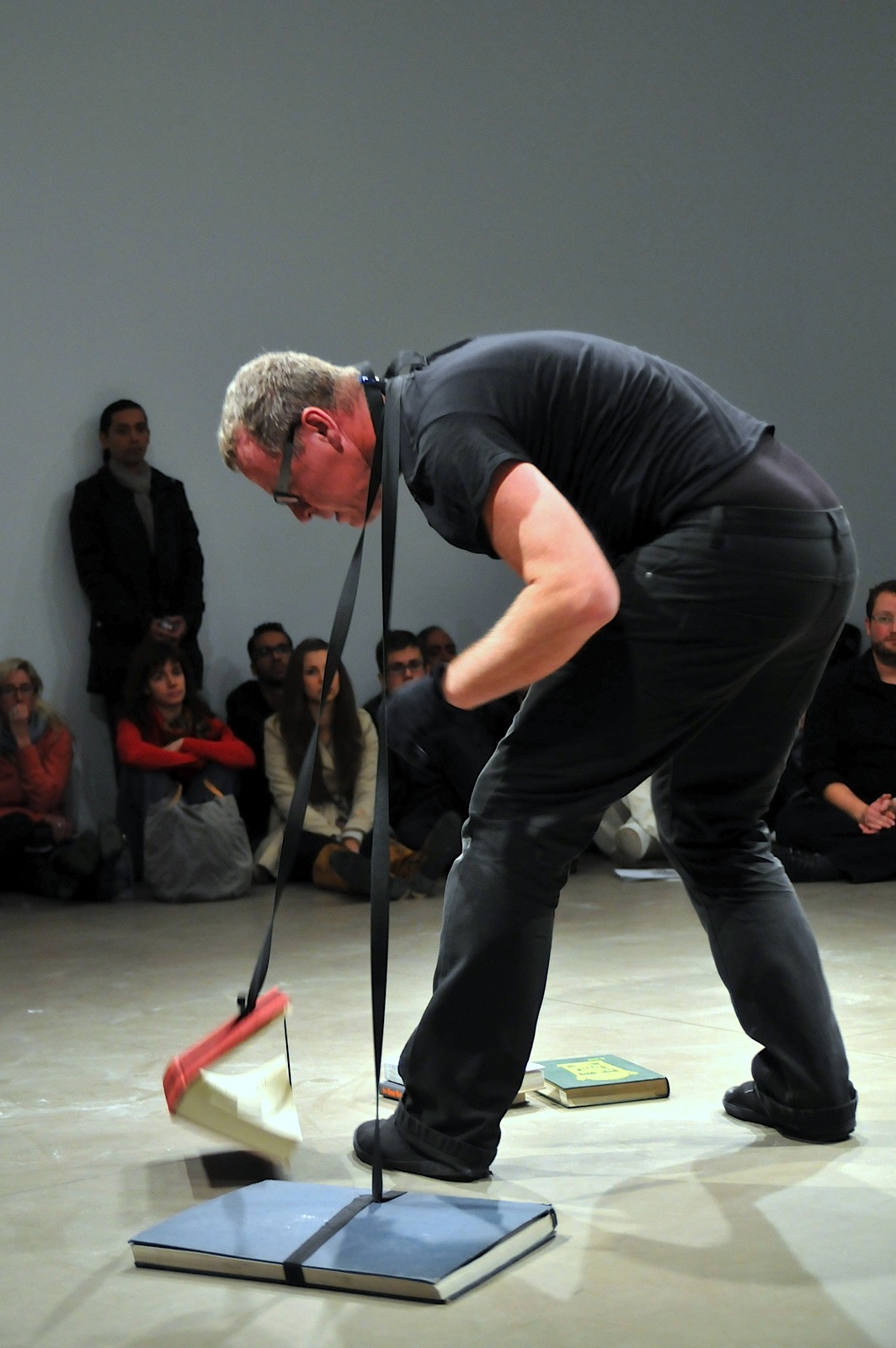

While Swedish artist Joakim Stampe was organizing an idiosyncratic array of props on the floor—a record player, books, a power drill, a can of beer—he commented, “I am going to show you some images I have never seen before.” He rubbed the record player over his body; he put a black bag on his head; he picked up a book whose back was a sculpture of a human face. He put a single on the recorder player, a folk song from the 1950s about an old revolutionary who had lost everything except his socialist ideals—the song was played over and over, to great comic effect, throughout the performance. At one point he put on a glove, wore the book with the face on its cover as a kind of sleeve, and began to touch and probe the audiences, begging for coins; at another point he drilled holes through the book and lay on his back with the book on his face, smoking a cigarette through one of the holes.

Photo of Joakim Stampe by Henry Chan
Although some of the things Stampe used in the performance seemed to have personal significance—the song was one his father, an artist and black listed socoalist, liked to play—his performance was less about specific symbols than about discovered new images, new relationships, and new responses.
Photo of Jolanta Lapiak by Henry Chan

Photo of (from left to right) Jolanta Lapiak, Jess Dobkin and Maurice Blok by Henry Chan
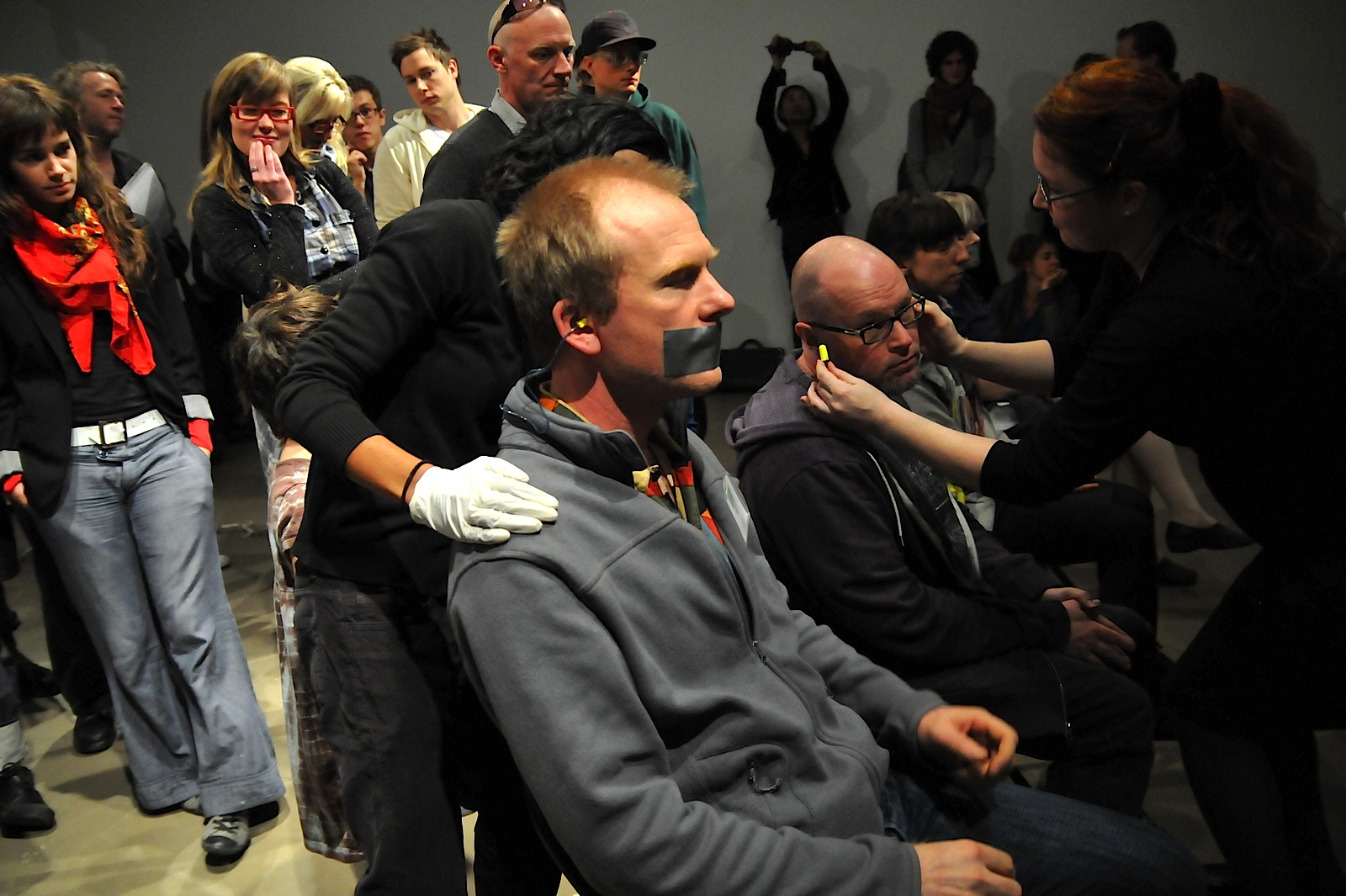
Photo of Paul Couillard, Jeffrey Byrd and Jolanta Lapiak by Henry Chan

Photos by Henry Chan

Canadian Jolanta Lapiak’s “De-hearingization,” on the other hand, takes a wholly differenct approach to performance than that of Videkanic and Stampe. Rather than focusing on the actions of one or more performers, her piece consisted of orchestrating participatry experiencescentered around destabilizing our hearing-centric concepts of language and communication. Accompanied by several other deaf performers, Lapiak had audience members’ mouths taped shut and ears plugged, then they were herded into small groups where they were taught rudimentary sign language without relying on hearing. At the end of the performance, everyone gathered in a circle around a paper chain made from torn out pages from a dictionary and broke the links in the chain. Like sight, hearing is a fundamental communicative sense, and relating to the world without it inevitably involves shifts in focus and priorities. Lapiak’s performance gestures toward recreating an aspect of this experience for those whose hearing is intact with the aim of making the point that language and communication are not in and of themselves dependent upon a particular organization of the senses.

Photo by Henry Chan


Photos of Carlos Monroy by Henry Chan
“Contemporary, aggressive, ownable….” Monroy’s hilariously disconnected corporate language serves to underscore a feature of performance art many of its practitioners take pride it—that it does not trade objects that can become commodities, that, Marina Abramovic aside, it does not depend upon the same star system that dominates most contemporary art. Then, halfway through his presentation, sultry Latin music came on, and Monroy, dancing to the new vibe, moved into the audience and began to strip. Jacket, tie, shoes, socks, shirt, pants, all of it came off as Monroy pumped and swayed his way through the small, seated crowd; by the time he resumed his more corporate personae, all he had on was a big white jock strap. “CMG Art Services,” he said, “Let art work for you!” So much of the art world today is bound up in celebrity artists (Abramovic was profiled in the Home and Garden section of the New York Times showing off her multi-million dollar country home!), dealers, collectors, institutions and name curators, and against this background Monroy’s performance was refreshingly naïve and bumbling. He doesn’t really know how to use Power Point very well; and the corporate marketing language is clearly alien to him.

Monday, October 25th 2010 (DB)

Photos of Jamie McMurry (above) by Henry Chan
Photo of Robin Brass (below) by Henry Chan


7a*11d Blog # 1
Performance art, as it is currently understood, owes a great deal to the spectacle of ritual, which might be roughly defined as a set of disciplined, symbolic acts that activate meaning within, and to some extent define, a sacred space. One thinks of the role of the Catholic mass in performances from early Tadeuz Kantor events to Diamanda Galas’ gothic rock operas, or the banquet table in Marina Abramovic’s earlier work. The allure of the idea of ritual or ceremony in performance is easy enough to understand, because it offers a model of how complex meanings can be enacted, literally and physically in time, without the trimmings of traditional theatricality. But the use of allusions to ritual and ceremony can also be dangerous: it can imbue a work with a false sense of solemnity, an aura of deeper meanings where none necessarily exist.


Photo of Robin Brass by Henry Chan


Photos of Jürgen Fritz and Gabe Gaudet by Henry Chan
Brass and Fritz’s performances take place within a broadly allusive ceremonial context within which they can be read and experienced. Japanese artist Kaori Haba’s work, by contrast, is domestic and intensely personal. According to Haba, she sets out in her recent performances to create an essay articulating her observations and perceptions using objects rather than words. The ordinary objects Haba uses in her performances—sand, bread, apples, neck ties, a rope—seem to be supercharged with meaning and emotion, as though they had been lifted directly from the unconscious. According to British psychoanalytic theorist Melanie Klein, much of our relationship to the world is mediated by the ways in which we introject objects and parts of objects into our interior world; in Haba’s performance world, those charged, thrumming, ambivalent objects have been spilled out onto the floor.

Photos of Kaori Haba by Henry Chan


Photos of Jamie McMurry by Henry Chan


“Women in Peace and War” is in a way fussy, precise. Like the work of fellow LA performance artist Paul McCarthy, McMurry’s sensibility is epically messy. “Ranchero” opens with McMurry standing beside a music stand taking a swig of Canadian Club, which he then dribbles from his mouth onto a saucer and proceeds across the space for an encounter with a picture of a Chevrolet Ranchero that is taped to the wall, an image that seems to have a scary, demonic significance for the artist. McMurry’s approach to performance, like that of McCarthy, is intensely physical, expiatory, and raw. He stands at length with his foot in a bucket of ice then attempts to pour the dirty, melted water down his throat. Eventually he fills his shirt with ice, cutting it open and letting the ice spill out onto the floor. The performance becomes increasingly obsessive and even harrowing. He attempts to guzzle whole buckets of paint, physically gagging as the paint spills over his face and naked torso. He attempts to drink an amalgam of paint and pebbles from the model of a house, and then, on verge of puking, demolishes the house with a bat. At one point he has a kind of shamanic skull rattle taped to his arm as he faces off with the Ranchero with cryptic gestures.
McMurry also asked the audience to participate in the performance, or at least provide additional materials. He photographed a member of the audience and then asked her to take a picture of his ass; he arranged the two developed Polaroids in cheap frames on a kind of alter. He sampled hair from select members of the audience, mixed it with water in a jar, and drank it down. Half naked and soaked through with paint, he pinned a metal to his bare chest, began shearing off his own hair, and recited rock lyrics in a slow, deliberate, deadpan voice: “Cali-for-niay knows how to par-tay…” After another spasm of destruction with a baseball bat, he led the audience out onto the street. Those who had participated earlier got in a mini-van that McMurry immediately doused with more buckets of paint, and then he proceeded to run down the street, waiving his baseball bat above his head, as though he were leading a riot.
The night of the performance was cold and rainy, and McMurry didn’t get far before he was pulled over by a patrol car. The police apparently pointed out to him that, when face with a half-naked, club-wielding man running down the middle of the street in cold rain, someone who looked outwardly insane or at least on drugs, they would be within their rights to simply shoot him. Fortunately that didn’t happen, and McMurry thereafter limited himself to the sidewalk as he wended his way on side streets to a local twenty-four-hour car wash, where a stretch limo and an astonished chauffeur awaited him. Californians know how to par-tay, and a few of those willing to weather the cold rain were treated with a ride in the stretch limo. Those in the mini-van were given loot bags assembled by McMurry’s wife back in California. The performance ended with McMurry getting a proper haircut.
If Brass and Fritz’s performances are anchored by open-ended and public symbols, those of Haba and McMurry are fueled by materializing the dynamics of very private worlds, and they are successful to the extent that they resist becoming wholly insular. In the end it is hard to say what forces McMurry is struggling with over the course of “Ranchero,” what the Ranchero ultimately represents, why he needs to tie a lamp to rubber tubing, stretch it to its limit, and unleash it against the wall, what exactly he is trying to internalize when he tips buckets of paint into his gaping mouth, what exactly he is destroying when he rips apart a wooden model house, why he needs to festoon himself with lengths of red and white tissue paper. McMurry’s performance was carried by the immediacy of the struggle itself, and the perverse ironies that arise along the way. Perhaps it doesn’t matter that we don’t really know the meaning of most of went on during a performance that lasted well over an hour. After all, most of our struggles are ultimately against forces we cannot identify much less understand.
Karen Elaine Spencer - sittin'
Tuesday, October 26, 2010 - Union Station 9 AM - 5 PM
this morning one of the 'red caps' walked over to where i was sitting, stuck out his hand, and said, "hi, i'm dan." i took his hand, smiled, and said, "hi, i'm karen."
Tuesday, October 26, 2010
The TouVA Collective (Sylvie Tourangeau, Victoria Stanton, and Anne Bérubé): The 7th Sense, Toronto Free Gallery, Tuesday October 26, 2010 (NL)
The space has chairs on two walls. In the center lies a bolt of red and yellow mottled cloth, three bottles of juice-like liquid (yellow, orange and red), three wine glasses, an orange, apple and banana stacked on three sheets of tissue paper (again, red, orange and yellow), and a long spiral of some kind of children’s candy encased in a tube of plastic. There are three books – Perform, Action, and a French edition of JL Austin’s How To Do Things With Words – three sheets of drawing paper, and two markers. A performance art still life.
As the audience mills around, the performers begin almost imperceptibly. I don’t even realize the performance has begun until a hush falls over the room - until enough people having stopped talking and begun paying attention to the performers (Anne Bérubé and Victoria Stanton) writing on two sheets of poster board (orange and yellow) against one of the walls where the audience is seated. Bérubé dictates the following list to Stanton:
One: Guest List, Two: Snakes and Ladders, Three: A Tribute To Françoise Sullivan, Four: Pogo-Sushi, Five: Katerine et les Trios Grâces, Six: Joan Jonas – My Shitake is your St Tropez, Seven: Beach Party!, Eight: Hey You!, Nine: Répéter au Besoin, Ten: I don’t know anything about you, Eleven: James Bond, Twelve: (number twelve is left blank), Thirteen: Blue Screen.
 Bérubé and Stanton move to the opposite side of the space, the side we're facing. By now all attention is on them. They put up two more pieces of poster board, Stanton directing Bérubé as to the straightness of the panels before dictating the list (the same list) of items. Bérubé has a thick French Canadian accent while Stanton is clearly English Canadian. The juxtaposition of accents places us immediately within a particular politics, whether willed or no – a politics of utterance. Same list, performed twice, heard differently. Meanwhile, Tourangeau sets up the juice and glasses on a small pedestal at the opposite side of the space and and asks the audience if someone will help her carry the bolt cloth. Someone does. Tourangeau gathers the fruit and tissue paper, sets them up at this side of the space, and asks another audience member whether the banana is best perched on the apple or on the orange. The audience member indicates the orange. She asks another audience member what a pile of masking tape rolls look like. Stairs, perhaps? The audience member suggests that they look like a cake. A cake! Ah! responds Tourangeau and then, after asking how the markers should be arranged in relation to the masking tape cake, she places them inside like a vase and walks to the center of the space.
 What is clear at this point is that we are witnessing actions or sequences that are loosely scripted. Attentive to the interior coherence of each action and its sequence as it unfolds, step by step, The TouVA Collective is, in some way, following the dictated list. What is unclear, and is only to become more and more unclear, is what the exact relation between the actions and the listed items is. Instead, we are brought firmly and unrepentantly into their private coded and experimental world. At one point in this world Victoria Stanton enters the space with a platter-like rectangle covered in a mix of glitter and little alphabet-shaped letters. As she slowly, ceremoniously, tilts the platter to let the alphabet glitter whoosh (quite beautifully) to the floor, the following imperative is revealed, written in glue: extract it. I don’t know exactly what I am meant to extract – perhaps meaning from among these absurdist actions and utterances? – but I will accept that order, now, as I reflect on my experience of the performance.
 Extract #1: Together Tourangeau, Stanton and Bérubé take a deep breath. They unfurl the bolt of cloth and cover the length of the space. At one end of the space Tourangeau lies across the cloth, width-wise, while Bérubé and Stanton stare at each other through the cardboard tube the cloth was wrapped around. One is leading and the other following, but it's unclear who is who. Like a mediated mirror game we follow their dance. The action completed, they cross to Tourangeau and roll her from one end of the space to the other. As she rolls, her hands stick out of the cloth over head, at first limp as if dead and then gently dropping first one, then another, then another penny onto the floor at uneven intervals. With the first penny I'm unsure – maybe an audience member dropped something? By the second penny it is clearly Tourangeau. Progressively it becomes clear that with her hands she is directing the actions of Bérubé and Stanton. They roll her this way and that and eventually unroll her completely. Bérubé and Stanton take her place and lie across the newly laid out cloth. Tourangeau brings the cloth up over them as if to tuck them in. She then places herself between them, holding a push-up position as long as she can. She pauses over the cloth as if to do something, but doesn’t and wanders offstage with a look both gleeful and naughty.
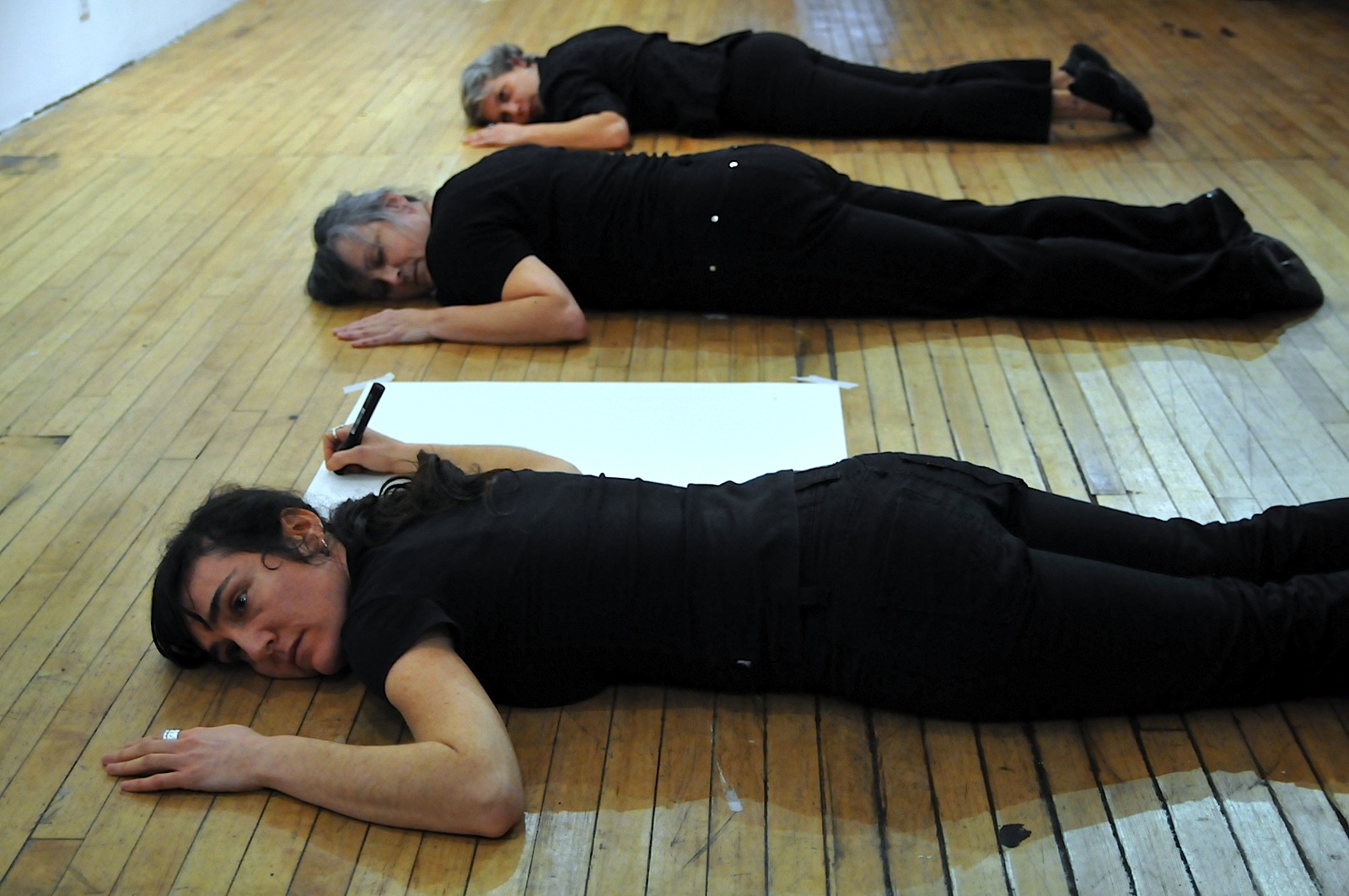 Extract #2: Bérubé, Stanton and Tourangeau enter the space, each with a marker and a piece of white poster board. In concert they tape the poster board to the floor, step to the left, and lie face down with their right hands holding marker to paper. They begin, one by one, seemingly in response to each other, to tap, squiggle, and otherwise make sounds with their (capped) markers. Somehow having signaled each other they each, then, remove the tops of their markers one handed and begin to write. The audience slowly -- once the ice has been broken -- stand up and crowd around to read the messages. Scrawled, drawing-like, and blind (each of their heads is turned away from the paper), the writing is mostly illegible. They finish the action by rolling back and forth until piled together.
 Extract #3: Standing in the center of the space, Tourangeau, Stanton and Bérubé each hold a book. One is called Action, another Performance. These flank a French edition of JL Austin’s How To Do Things With Words. The women begin a round-robin call and response riffing on Austin’s central example of the performative utterance: the “I do” uttered in a marriage ceremony. Do you take this commitment? I do. Do you take this seriously? I do. Do you take this lightly? I do. The women play with the I do in a context famously considered by Austin to be unfelicitous: the performance space. Bérubé and Tourangeau leave the space. Stanton, left in the space, pours herself a yellow glass, raises her glass to us and stands still. We wait. She doesn’t drink but returns the full glass to the table and leaves the space.
Extract #4: The three performers have left. There is a pause. The audience looks at each other. (What happened? Is it over?). The wait becomes uncomfortable. Just as it is about to become too too uncomfortable, Stanton comes back with some yellow folded clothes. She changes shirt. Pants. Socks. Then Tourangeau and Bérubé come back too, having changed into red and orange respectively offstage.
Extract #5: Bérubé gets into an argument with either Tourangeau or Stanton – it is unclear which. She puts on a hat and purse and leaves the space. Half of the audience can see her outside and laugh. Those of us on this side of the space have no idea what is going on. Stanton joins Bérubé outside. Tourangeau drops the banana and leaves. Bérubé and Stanton re-enter, Bérubé hands an audience member a cigarette that she lit while outside, and they both follow Tourangeau out of the space. We wait, trained to expect long pauses, for them to return, but they don’t. An audience member tells us that it's over. We pause, unbelieving.
No, really: it’s over.
The performance ends as it began, with uncertainty. The 7th Sense operates much like life – it begins before you really know it is happening, is heavily structured for much of the middle, and the end takes us by surprise.
Monday, October 25, 2010
Karen Elaine Spencer - sittin'
Sunday, October 24, 2010 - Union Station 10 AM - 5 PM
every morning i take myself to a place of transit. here i sit, mostly; but i also stand up, walk around, go to the washroom, eat and drink. i do not read or write, text or call, photograph or videotape. nor do i capture sound. at the end of the day i walk back to my hotel and write my sentences for paul to upload onto this site.
Sunday, October 24, 2010
Karen Elaine Spencer: Sittin’, Union Station, Sunday October 24, 2010 / Day Four (NL)
We are less than halfway through Spencer’s ten-day performance action: sitting for eight hours a day on a set of benches near the Front street entrance of Toronto’s Union Station. I approach the performance site half expecting not to see her. Expecting that at this point she might foil expectations, change the rules of the piece and sit somewhere else. But no, she is still there. And this makes sense, as one of the things that Spencer is curious about is how long she can “loiter” in one site before someone – anyone – asks her what she is doing there.
I approach her, ask how her day has been - it's now four, the workday is almost done - and about yesterday. It was great! she says. A couple people came to see me after reading the blog and sat there watching me for an hour before introducing themselves. I had no idea I was being watched. I sit down with Karen again and think about this. I look around. Could I mistake anyone for a surreptitious observer? There’s one young man, maybe twenty years old, texting and glancing up now and then. He could easily be an art school student. I look off into space, sitting, and imagine him watching me. A wedding party enters. A woman with a limp passes by. A Muslim woman struggles by with a baby carriage and too many suitcases. Someone catches my eye and then looks over at Karen. Is he here for the performance? No, his eyes move on and land on his travel partner and they move off.
If day one, for me, was about sight, and day two was about sound, today what I notice most is the cold. These seats are directly in front of some vents and after only twenty minutes I am chilled to the bone. The other thing I notice is a kind of anxiety linked to boredom, both actual and prospective. I am not actually bored, but the moment I stop and just sit, contemplating eight hours a day every day, I begin to feel the oh god what have I gotten myself into and how and I going to do this that I often feel at some point near the beginning of my own durational pieces. It's a sensation linked to moving towards the unknown in an experience. It's a sensation linked to any act of experimentation: the parameters are set up and the phenomenological journey embarked upon, in all its unexpectable complexity.
 Spencer spends most of the time I'm there alternating between sitting and standing next to the chairs. While the performance is called Sittin’, today it is more about loitering than sitting. Sitting as synonymous for occupying space. I loiter, in solidarity, and wonder how long it will take for someone to say something to her – whether a question: what are you doing here everyday? Or a command: stop sitting here every day. I also wonder at my desire for exactly that – for some drama. I remember Spencer talking to me a bit about her inability to just drift off and relax during her days because of the site she has chosen: directly in front of the “Red Caps” – people who function, as far as I can tell, as a mix between security officers and porters. Sitting in front of them keeps her always alert to her role as public performer, as interloper, as potential problem. I think about this as I loiter in front of the Red Caps, trying to ignore them and dissolve into my surroundings, go back into the visual or sonic detail of the site. I listen to the echo of the hall, to a couple arguing in a corner. I wonder how long it would take me to exhaust my surroundings and what, exactly, exhaustion might mean in this context? Would I just keep peeling layers away from the space like an onion? Only if I wasn't chilled to the bone. Maybe someone reading this will bring Spencer a windbreaker...
[Image by Henry Chan, from a different day]
Subscribe to:
Posts (Atom)